City Ruinous
The Silver ChairCity Ruinous is the ruin of a vast city built by giants, and the site of a crucial missed instruction in the search for Prince Rilian. Its broken pavement and buried depths make the place both a legible record of the giants’ former scale and a threshold the travelers must find their way beneath.
Discovery and Landscape
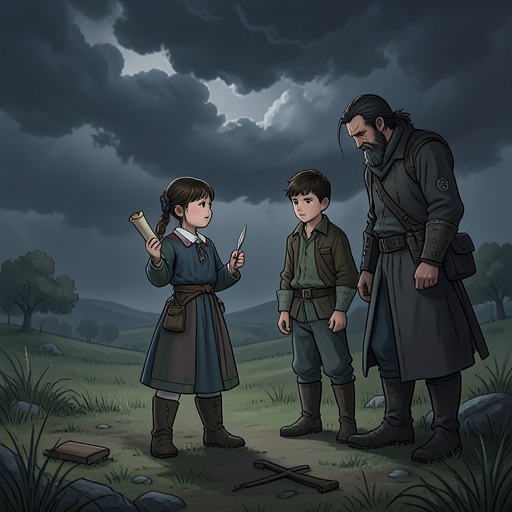
The city enters the quest first as a destination rather than a place the travelers have seen. Jill Pole recalls that Aslan said they must begin by finding a ruined city of giants; Puddleglum answers with his characteristic precision, distinguishing finding it from setting out to look for it. The distinction foreshadows how easily the travelers’ attention can slip from the instructions themselves.
Before the city is recognized, the travelers cross a flat, lonely marsh. Channels divide its plain into countless islands of coarse grass, edged with reeds and rushes; flocks of water birds rise and settle among the reeds, while widely spaced wigwams reflect the Marsh-wiggles’ preference for privacy. The marsh opens eastward toward distant sand hills and the sea, and northward toward low pale hills. Under morning sun and a fresh wind its solitude seems clean and invigorating, though the same terrain would be bleak in wet weather. This open, bird-filled landscape is a marked contrast to the ruin’s exposed heights and, later, to the subterranean darkness beneath it.
After the travelers’ conversation with the Lady of the Green Kirtle, the route grows harsher: a north wind drives through narrow valleys, there is no firewood or shelter, and stony ground makes walking and sleeping painful. The party’s thoughts turn increasingly to the beds, baths, and hot meals promised at Harfang, while Jill stops repeating Aslan’s signs to herself. The city’s approach is therefore bound up with a weakening attention to the quest, not just with difficult terrain.
The Ruins and the Missed Sign
The travelers reach the city across a flat-topped hill in a storm. From the ground, they can see little: the wind drives snow across the plateau, its surface is slick, and low banks crisscross it in irregular squares and oblongs. Jill notices shapes that resemble factory chimneys and a cliff with an unnaturally straight face, but she is preoccupied with the cold and the comforts she hopes to find at Harfang. What seems an inhospitable natural landscape is, from above, the city itself.
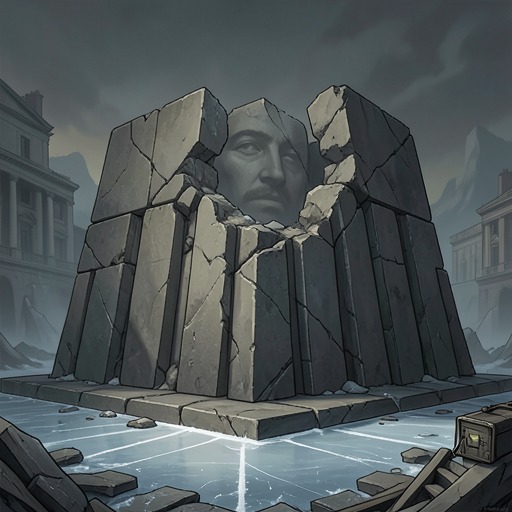
The next morning, from a castle window, the thawed snow reveals the plateau as a ruined city paved in places and broken in others. The banks that had obstructed the travelers are remnants of the walls of enormous buildings, perhaps giant palaces and temples. A standing wall about five hundred feet high accounts for the apparent cliff; what looked like chimneys are colossal pillars broken at uneven heights, with fragments scattered at their bases like felled trees. The ledges on the hill’s northern side, and presumably those on the southern approach, are the remains of giant stairways. These details transform the travelers’ earlier, partial impressions into a comprehensible urban landscape.
Across the pavement, in large, dark letters, lies the inscription “UNDER ME.” The travelers had walked through the lettering without understanding it: Eustace Scrubb reconstructs their route as a passage along the strokes of the letter E in “ME,” including turns that brought them back around. He recognizes that they have missed the second and third signs. Jill blames herself, but Puddleglum reads the words as an instruction to search for the Prince beneath the city. The ruin’s sign was not absent; the travelers had been physically inside it and failed to perceive its meaning.
Beneath the City
Puddleglum holds that Aslan’s instructions work without exception and reasons that, had the travelers been attentive at the ruins, they might have found a door, cave, or tunnel leading below the paving. By the time they understand the message, they cannot identify that missed entrance. Their eventual descent beneath the city restores the route to the instruction, even though it does not undo their earlier failure to follow it at the proper moment.
In the Underworld, the children draw close to Puddleglum as a boat, lit by a pale lantern, moves over dark water. The lantern reveals little beyond the vessel; ahead is smooth water fading into blackness. Puddleglum steadies Jill by insisting that they are now under the Ruined City and following the instructions again. The underground passage makes the inscription’s direction literal: the quest proceeds below the place whose surface clue they overlooked.
The subterranean setting later becomes a zone of catastrophic change. As the Witch’s kingdom collapses, ships are driven from the harbor into the streets and the rising sea floods the city. The castle stands on high ground, but the water advances quickly. During the escape, the travelers and their horses cross a valley where the tide is running through like a mill-race; it is still only a foot or two deep, yet the current makes the crossing dangerous. The waters spread until the hills of Underland are islands and distant lamps disappear. City Ruinous thus connects the quest’s physical descent with the larger peril of the collapsing realm: the way beneath the ruin leads into a world whose routes and refuges are being submerged.